I HOPE EXCEPTING THE INVITATION TO NEW YEARS IS NOT A MISTAKE... I DO NOT NEED ANY CRAP..
I DON'T KNOW IF I AM STRONG ENOUGH.
Friday, December 28, 2012

Currently reading A Fatal Winter G. M. Malliet
A tiny village in the English countryside during a storm-wracked winter. A house
party at the local castle that ends in two deaths. A dishy vicar, formerly an
MI5 agent, summoned to the castle to solve the certain homicide of the lord. Put
it all together, and this is one gift-wrapped package for cozy lovers and Agatha
Christie devotees. But it is also a pretty cheeky cozy, written by someone who
knows how to use the conventions and poke fun at them at the same time. In the
second in the series starring vicar Max Tudor (following Wicked Autumn, 2011),
Tudor escapes the amorous clutches of the church ladies in Nether Monkslip to
visit Chedrow Castle in the wake of the deaths of Lord Footrustle and Lady
Baynard. (An old cop friend wants Tudor on the scene to observe the viper’s nest
of relatives.) Tudor’s observations on evil, honed by both his spy and vicar
backgrounds, are one of the best features of this thoroughly entertaining
mystery. --Connie Fletcher
THIS IS A GREAT BOOK I ESPECIALL LOVE THE WAY SHE DISCRIBES THE CASTLE... I AMD 3/4 THROUGH AND DON'T KNOW WHO DID THE MURDER ..... THE CHARACTERS ARE WELL DEVELOPED......
THIS IS A GREAT BOOK I ESPECIALL LOVE THE WAY SHE DISCRIBES THE CASTLE... I AMD 3/4 THROUGH AND DON'T KNOW WHO DID THE MURDER ..... THE CHARACTERS ARE WELL DEVELOPED......
Tuesday, October 2, 2012
THEVAULT
JUST FINISHED THIS BOOK WOULD GIVE IT A 10/10. I LOVED THE PLOT MYSTERY ABOUT A OLD BOOK AND FINDING WHERE IT CAME FROM... WOULD LIKE TO READ MORE BOOKS LIKE THIS FOR SURE
I READ THIS DURING MY TRIP TO SEABROOK ISLAND AND WHEN I GOT HOME AND DURING MY FIST FEW DAYS AFTER THE BREAKUP WITH BOB... NOW I MUST DECIDE ON THE NEXT BOOK... ONLY A FEW HUNDRED TO CHOSE FROM....
Curmudgeonly Chief Superintendent Peter
Diamond (The Last
Detective, Bloodhounds, The
Summons) is once again suffering fools (to which category he currently
consigns Americans, antiques enthusiasts, and his immediate superiors) none too
gladly. When a skeletal hand is found in the cellar of the abbey churchyard in
Bath, Diamond is inclined to write the apparent crime off as the dusty wages of
a long-forgotten sin. But then a skull turns up. And then Joe Dougan,
mild-mannered American professor and avid literary tourist, unearths the
startling fact that in the early 19th century that cellar belonged to the home
Mary Shelley lived in as she was writing Frankenstein. Glorious fodder
for the sensationally minded press and a monstrous headache for Diamond, who
would prefer to cogitate upon the mystery in peace and quiet.
But it seems that the literary connection is as crucial as it is sensational.
When Dougan's wife disappears and Peg Redbird, proprietress of the Noble and
Nude antiques store, turns up dead after a heated conversation with the
professor (in hot pursuit of Shelley's writing desk and sketchbook), Diamond has
to wonder whether a thirst for knowledge also implies a thirst for blood. As
Diamond immerses himself in Bath's cultural history, however, more and more
suspects pop up, linking the long-dead bones in the cellar to Peg's very recent
corpse. Author Peter Lovesey, with a nod and wink toward the conventions of
traditional British mystery fiction, paints his characters with broad strokes:
like the characters in a game of Clue, the suspects are easily labeled. Is it
the spoiled heir who dunnit? What about the up-and-coming reporter? Or the
cryptic puppeteer? Or (and this is really giving Diamond ulcers) the suave city
councilor, who happens to be good friends with Diamond's boss? Lovesey tiptoes
agilely just this side of caricature--and has a great deal of fun doing so.

Diamond himself is an enjoyable enough character, though his grouchiness
seems to be missing some of the verve it had in earlier books. One might take
issue with the novel's sense of pacing (at times funereal), and with Lovesey's
narrative gimmick of switching occasionally to the murderer's perspective (too
Gothic a trick for a relatively unexciting plot). These complaints, however,
don't detract from an otherwise solid entry in the Superintendent Diamond
series. --Kelly Flynn --This text refers to the Hardcover
edition.
From Publishers Weekly
THE END
ON SEP 16 SUN EVENING ON THE WAY HOME FROM VACATION WITH LINDA AND MARY MY 8 1/2 RELATIONSHIP WITH BOB ENDED. FINDING OUT THAT HE HAD BOUGHT BUNK BEDS FOR SUMMER'S KIDS, GIVEN HER A NECKLACE, TAKEN HIOUT TO EAT AND TO SHOWS WAS THE LAST STRAW....I CALLED HIM AND TOLD HIM TO GET OUT OF MY HOUSE AT NIGHT WHEN i WOULD BE THERE AND TO GET HIS STUFF OUT DURING THE DAY. WITH LOTS OF HELP THIS HAPPENED
I WENT TO THERAPY TODAY AND WILL MOVE FORWARD AND NOT LET SOMETHING LIKE THIS HAPPEN AGAIN. TRUELY THAT PART OF MY LIFE IS DEAD.....
AS JIMMY BUFFETT SAYS BREATHE IN BREATHE OUT
MOVE ON.....
I WENT TO THERAPY TODAY AND WILL MOVE FORWARD AND NOT LET SOMETHING LIKE THIS HAPPEN AGAIN. TRUELY THAT PART OF MY LIFE IS DEAD.....
AS JIMMY BUFFETT SAYS BREATHE IN BREATHE OUT
MOVE ON.....
Sunday, September 16, 2012
Civil war battle in waynesville
The "Battle" of Waynesville
Waynesville was the scene of the last and perhaps most unusual skirmish in the eastern theater of the American Civil War. On May 6, 1865, Union Colonel William C. Bartlett's 2nd North Carolina (Federal) Mounted Infantry were raiding, pillaging, burning homes and engaging in other activities to undermine the economic base of the area and were attacked at White Sulphur Springs (east of Waynesville) by a detachment of rebels from the Thomas Legion of Highlanders, who had been summoned for help by locals. East of the Mississippi, Thomas' Legion fired "The Last Shot" of the Civil War in White Sulphur Springs, North Carolina. The Legion consisted of soldiers who had served under Jubal A. Early during the Shenandoah Valley Campaigns of 1864, but had been sent back to their native North Carolina mountains to engage in guerrilla warfare against the remaining Union forces. The disoriented Union soldiers retreated into Waynesville, and on the evening of May 6 remaining elements of the Thomas Legion surrounded the town. The soldiers lit numerous bonfires on the ridges above the town and engaged in war chants in an effort to intimidate the Federals. The following day the Confederate commanders Gen. James Green Martin and Col. William Holland Thomas (for whom the Legion was named) negotiated a surrender. These commanders had been made aware that Generals Robert E. Lee and Joseph E. Johnston had already capitulated and that continued hostilities would prove pointless.
Waynesboro. Nc. Stayed sep 15
The Town of Waynesville was founded in 1810 by Colonel Robert Love, an American Revolutionary War soldier. He donated land for the courthouse, jail, and public square, and named the town after his former commander in the war, General "Mad" Anthony Wayne.
Waynesville also has a connection to another war. With news of General Robert E. Lee's surrender traveling slowly, the American Civil War continued in Western North Carolina. The final shots of that war, east of the Mississippi River, were fired near Sulphur Springs and General James Martin surrendered honorably on May 9, 1865 (See The "Battle" of Waynesville below.)
The Town of Waynesville was incorporated in 1871. In July 1995, the towns of Hazelwood and Waynesville merged into one community and continued to grow with a population today of almost 10,000.
[edit]Frog Level
Frog Level Historic District
| |
  | |
| Location: | Roughly bounded by Commerce and Boundary Sts., Water St. and Richland Creek, Depot St., and 80 Commerce St.,Waynesville, North Carolina |
|---|---|
| Coordinates: | 35°29′40″N82°59′26″W |
| Area: | 4.9 acres (2.0 ha) |
| Architectural style: | Early Commercial, Romanesque |
| Governing body: | Local |
| NRHP Reference#: | 03000854[5] |
| Added to NRHP: | August 28, 2003 |


Waynesville began to see development after arrival of the railroad in 1884. The agricultural, lumber and tourism industries in Waynesville and Haywood County began to thrive as access to the west was opened up.
The area of Waynesville located along Richland Creek, northwest and down hill from Main Street, was where the railroad tracks were laid. Until this time the area had been essentially a swampland, with a few scattered buildings but no major development. Once the depot was built and the train arrived this section was developed. It was given the name of Frog Level. Frog Level was so named by the local community because of its low-lying location along Richland Creek, the "frog level" when the area flooded.
Downtown and the nearby Frog Level commercial centers of Waynesville continued to be the central focus for social life, transportation, and wholesale and retail businesses through the 1940s. Businesses in the Frog Level area in the 1930s and 1940s included hardware stores, farm supplies, coal sales, auto dealers and garages, furniture stores, wholesale groceries, warehouses and lumber companies, all businesses dependent on the railroad. However, as the automobile became the primary mode of transportation for most residents, the railroad declined in importance. This in turn lead to a shift of business away from Frog Level. The last passenger train arrived in Waynesville in 1949, and freight trains pass through Frog Level twice daily, with most trains continuing on to Sylva.
By the 1980s the railroad in Waynesville had been integrated into the Southern Railway Company system. The first depot burned in 1900, but it was soon replaced with another depot that remained standing until 1987.
[edit]Neighborhoods
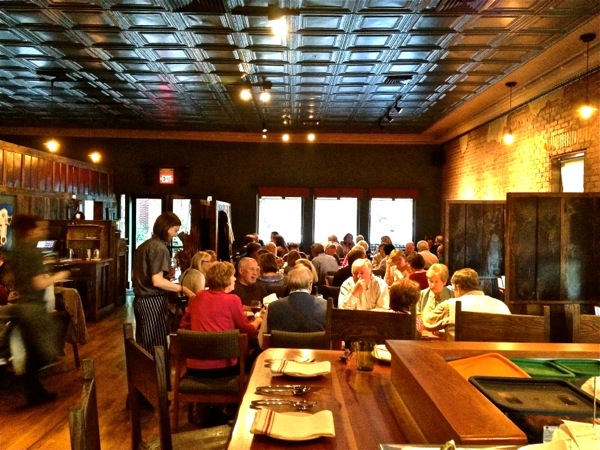
Where we ate
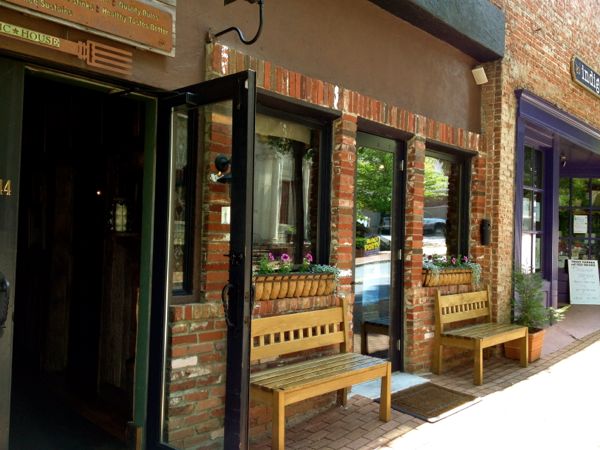
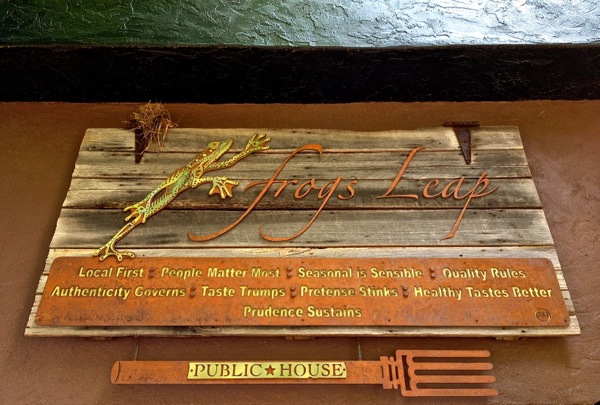
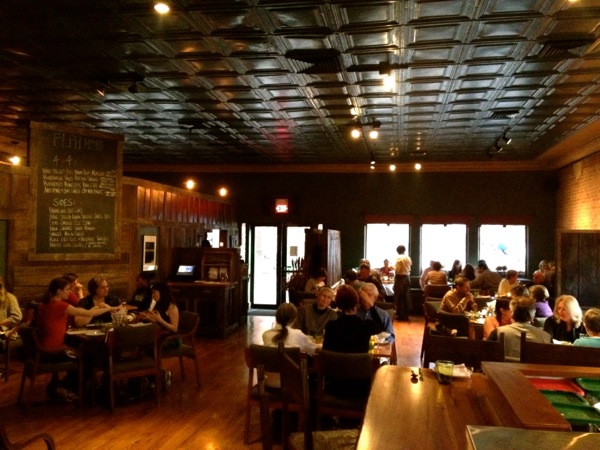
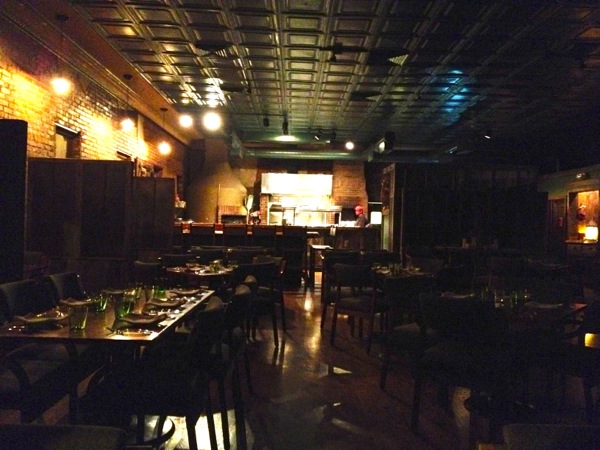
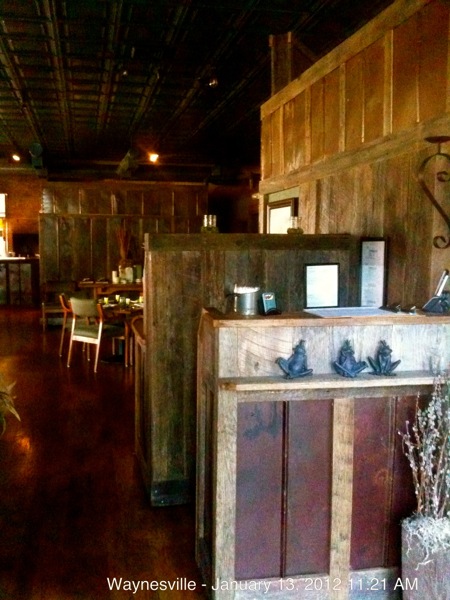
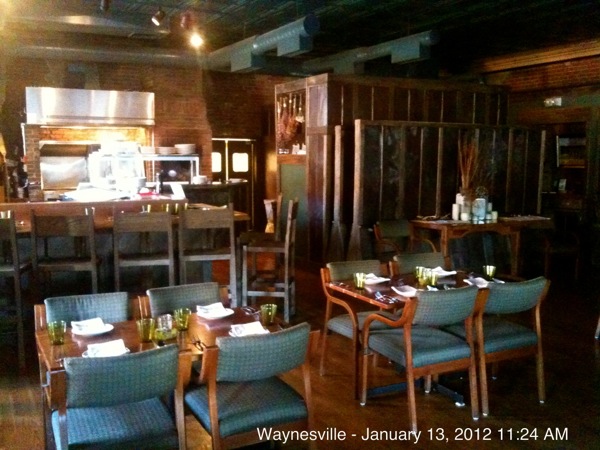
Frogs Leap Public House
__________ _____________
_____________
A Unique Farm to Fork Experience: Innovative Southern Food with a Local Backbone
& Home Grown Libations
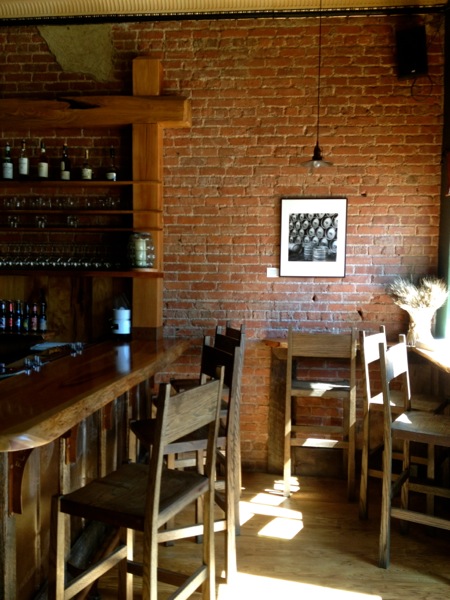
Frogs Leap Public House is a farm to table country pub at the corner of Church and Montgomery Streets, built in 1918 as the southeast’s first Buick dealer just one block south of Main in the heart of historic downtown Waynesville. FLPH is focused on the culture, art, music, wine, beer and especially the food of Western North Carolina. Owners Toni & Kaighn B. Raymond have come to Waynesville to open Frogs Leap Public House, their debut restaurant, after spending the past 20 years fine-tuning their concept while running fine dining restaurants in Georgia, Tennessee and beyond.
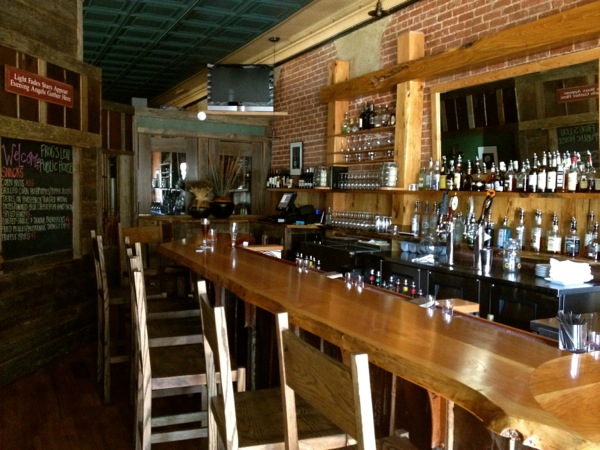
Like the City of Waynesville itself, FLPH is Southern down to its roots, but draws influences from around the world. The food is fresh and local, the libations are home grown, the music is American and has a beat. FLPH is home to a family with a passion for serving world class food, wine, and spirits in a soulful, comforting atmosphere. This is a place where business diners eat alongside families and foodies on any given day. The menu may feature duck confit and black truffles along with BBQ and pimento cheese. It’s a place to go for a local craft beer after work or to celebrate a special occasion. FLPH offers a carefully selected list of fine wines by the bottle and glass, award winning craft brews both on draft and in bottle. A sipping list including single malt scotches, bourbons, rye, brandy, port and a seasonal list of home grown cocktails created with house-made syrups, infusions and garnishes.
FLPH always uses the highest quality local ingredients to create ever changing menus that represent a fresh take on Southern Food. We source our meats, cheese, poultry, seafood, produce, and specialty products from a bounty of North Carolina farmers, ranchers, and artisans whenever possible. At FLPH, seasonality, sustainability, and buying local are our core culinary and business philosophies, and are achieved through preparing the best food, using the best ingredients, supporting our local economy, and conserving our natural resources. Frogs Leap’s great locally sourced ingredients are further enhanced through natural cooking techniques, an authentic wood-burning pizza oven, a slow smoker and an Argentine wood grill impart the warm glow of the North Carolina woods to our dishes.
Frogs Leap is an environmentally responsible business. We print menus in-house on recycled paper to allow creative use of seasonal, local ingredients while maintaining a consistent menu that you will recognize through the seasons and return for. We recycle, reduce energy consumption and convert our used cooking oil into bio fuel. We are proud of the fact that we are recycling and composting nearly every ounce of product that comes through our doors. We have no dumpster as we recycle or compost everything and hope to one day return our compost to a garden where we will grow delicious, homegrown vegetables and herbs that will complete the cycle as they make it directly to our guests through the Frogs Leap Public House menu.
Local First:People Matter Most:Seasonal is Sensible:Quality Rules:Authenticity Governs:Taste Trumps:Pretense Stinks:Healthy Tastes Better:Prudence Sustains





Subscribe to:
Posts (Atom)