Now oct 2020 66 years old
Tuesday, November 12, 2019

Sunday, October 27, 2013
THREE DAY ROAD
Set in Canada and the battlefields of France and Belgium, Three-Day Road is a mesmerizing novel told through the eyes of Niska�a Canadian Oji-Cree woman living off the land who is the last of a line of healers and diviners�and her nephew Xavier.
At the urging of his friend Elijah, a Cree boy raised in reserve schools, Xavier joins the war effort. Shipped off to Europe when they are nineteen, the boys are marginalized from the Canadian soldiers not only by their native appearance but also by the fine marksmanship that years of hunting in the bush has taught them. Both become snipers renowned for their uncanny accuracy. But while Xavier struggles to understand the purpose of the war and to come to terms with his conscience for the many lives he has ended, Elijah becomes obsessed with killing, taking great risks to become the most accomplished sniper in the army. Eventually the harrowing and bloody truth of war takes its toll on the two friends in different, profound ways. Intertwined with this account is the story of Niska, who herself has borne witness to a lifetime of death�the death of her people.
In part inspired by the legend of Francis Pegahmagabow, the great Indian sniper of World War I, Three-Day Road is an impeccably researched and beautifully written story that offers a searing reminder about the cost of war.
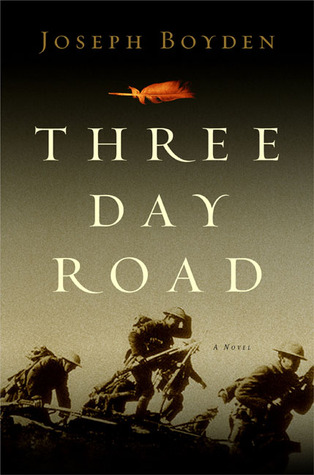
Set in the bush country of Canada and the battlefields of Europe, Three Day Road takes readers deep into the horrors—physical, emotional and spiritual—of World War I.
The story is told through the voices of two Cree Indians—the young Xavier, who has returned from the war badly wounded and in the grip of morphine addiction, and his aunt Niska, who cares for him and tries to restore him. Xavier had entered the war at the urging of his friend Elijah. Once they get to the front lines, their native hunting skills impress their superiors and both become snipers. They kill many men, but while Xavier feels a kind of spiritual revulsion, Elijah revels in it and tries to notch more kills than any other sniper in the war. His bloodlust completely masters him and he kills with both detached coolness and frenzied violence, disobeying orders and committing atrocities against the enemy, against civilians and even against his fellow soldiers. His addiction to morphine only quickens his moral dissipation. As Xavier remembers the nightmare of war, he struggles with his own addiction, the loss of his leg and the certainty that he will die after his morphine runs out. But Niska watches over him and "feeds" him healing stories of her past, his own past and of the larger past of their people. Whether she will be able to save him, to bring him back to life, creates the suspense that drives the narrative to its surprising conclusion.
Inspired in part by the life of Francis Pegahmagabow, the great Indian sniper of World War I, Three Day Road is a compelling and viscerally powerful exploration of what war does to us and how we might heal from it.
 In the summer of 1945, my father was invited to Buckingham Palace by the king. The war in Europe had ground to an end in the streets of Berlin. As George VI pinned the Distinguished Service Order upon my father's uniform, he proclaimed my father the most highly decorated medical officer in the British Empire.
In the summer of 1945, Erl, my dad's older brother, was living a traditional lifestyle in a teepee near Algonquin Park, selling crafts to tourists. Uncle Erl had experienced World War I and was too old for this second great war, but I doubt he would have wanted to participate anyway. He enjoyed life in the woods of northern Ontario in summer and the life of a world wanderer in winter.
I'm thirty-eight, the third youngest of eleven children born into a strict Irish Catholic family. My age betrays the fact that my father sired a number of my siblings, including me, when he was quite a bit older than most fathers. I grew up with history and myth swirling around me, stories of my father's war exploits and my uncle Erl's Ojibwa ways inseparable. I was born into a family from a very different era and listened to stories of how my father and Erl and their younger brother Robert had to form their own gang when they were young because they were Mick Catholic bastards in a world of Orangemen. My father was older than most of my friends' grandfathers, had actually delivered a number of my schoolmates' fathers into the world.
My father was blond and blue eyed. Erl was brown and high-cheek boned and had a hooked nose. Robert looked something in the middle. My father chose one route. He became a doctor and a war hero and brought his family to the city. Erl took the other route. He lived in the bush and made his own clothing out of hide and traveled the world with only a few coins in his pocket, somewhere along the way picking up what now sounds like the horribly racist moniker "Injun Joe." There are still postcards of him in full Indian regalia floating around Algonquin Park trading posts. Robert chose a quiet life somewhere between the two.
My dad died when I was eight. Erl took the three day road years earlier. Robert died not long after my father. My raven-haired mother, strong and still beautiful, was left to raise my sisters and brothers and me. She was no stranger to war veteran relatives, either. Her father, Guy, had been a motorcycle dispatch rider in World War I, had had the dubious distinction of being wounded on November 11, 1918, the last day of the war. He spent the rest of his life blinded in one eye from shrapnel.
With so many children to keep track of and a full-time job as a teacher at the local elementary school, my mother was forced to grant a certain amount of lenience to my wandering ways. Just like my Indian uncle, I had a taste for the road and for adventure. The punk rock scene of the early 1980s was a nice fit for my rebellious sensibilities. In deference to my uncle, I wore my hair in a mohawk, lived on the streets of Toronto in the summers, returning home to pursue my schooling in the autumn. At the time, I didn't recognize the parallels between my uncle and me.
At sixteen, I began traveling to the States on my own. More and more I felt the inexplicable pull of the Deep South, making close friendships with a group of misfits in South Carolina and Louisiana. I became a roadie for their band and crisscrossed the Unites States and Canada with them. Responsibility, the ghostly apparition of my father, always pulled me back to continue with my schooling. I kept all kinds of jobs in order to feed my growing passion for the road: gravedigger and groundskeeper at a cemetery, tutor, dishwasher, waiter and bartender. But always, as soon as my last exam was finished, I'd climb on a Greyhound, or stick my thumb out or jump on my motorcycle and hit the road once more.
I fancied myself a writer, eventually enrolling in the MFA program at the University of New Orleans. Here I finally learned to focus my energy and work ethic in a city that seemed too good a fit at times. I met my wife, Amanda, here, a trapeze artist, contortionist and writer.
But the pull of my home and my family is strong. I returned with my wife to Ontario and took a job as professor of aboriginal programs on James Bay in the far north. Here I was introduced to the Mushkegowuk Cree, northern cousins of the Ojibwa. Stationed in Moosonee, I worked for two years up and down the reserves of the west coast of the bay—Moose Factory, Fort Albany, Kashechewan, and Attawapiskat—teaching communications, my wanderlust satisfied by moose and caribou hunts and snowmobile treks into the frozen wilderness of Hudson Bay. Over the last ten years this gateway to the last great wilderness has become my muse and obsession, refusing to loosen its grip on me even now that I am back in New Orleans teaching in the same MFA program that birthed me. I visit what have become old friends on James Bay a number of times a year.
It seems I'm a bit of a split personality, a combination of my father and my uncle Erl. I have my father's responsibility and my uncle's belief that the world is to be traveled. I split my life between the Gulf of Mexico and the gulf of the Arctic. I write and I teach writing. My heart is part Irish, part Ojibwa. I'm a Canadian in America. I'm grounded by history, and I am inspired by legend. I'm part my father, part my uncle. I am a father to my son, Jacob, and I am a writer.
What inspired you to write Three Day Road? What is your personal relationship to the story you tell in the novel?
Having grown up the son of a man whom King George VI declared the most highly decorated medical officer in the British Empire, I was surrounded and obsessed by the complications and myth of war. My father didn't talk to his children about his experiences, but I was a reader and investigator from a very early age, finding Toronto Telegram news stories describing his exploits on the Gothic Line in Italy. It seems my dad had a penchant for rescuing wounded soldiers in the midst of enemy fire on the front line. Rummaging through our house, I also found his many medals, newspaper pictures of his returning from Europe and a parchment signed by the king himself inviting my dad to the Court of Saint James's to receive his Distinguished Service Order.
Beyond my dad's war experience, my mother's father and my father's brother both served in World War I, the first as a motorcycle dispatch rider, the second as an infantryman. I spent much of my youth on and around Georgian Bay, near both Christian Island and Parry Island reserves, and it was here my Ojibwa friends first told me the legend of Francis Pegahmagabow, the great Indian marksman of the First World War. He was an adept hunter, able to lie still for days in no-man's-land, and by war's end recorded more enemy kills than any other sniper in the Great War, or any war, for that matter. He returned to Parry Island a hero, becoming chief of the reserve. And yet very few people know of him anymore. The idea for my novel began as a combination of my own family's history combined with the myth of Francis.
Why did you decide to begin the novel at the end of the story, after Xavier has come home?
The first couple of drafts of the novel were actually told chronologically: Xavier and Elijah paddling away from their home, eventually getting to Toronto, going through training, being sent overseas and experiencing the war. Interspersed in the novel were chapters narrated in a strange woman's voice, telling the stories of her life. In the original version, it wasn't until three quarters of the way through the book that the reader finds out that this woman is actually Xavier's aunt, Niska. I liked this surprise of the reader's discovering who Niska was late in the novel. As well as this, chronologically writing the first draft also helped me to find the story and be historically accurate. But I wasn't satisfied with the way the story read. Something, some key ingredient, was missing.
In different conversations with the editors Marc Cote and Francis Geffard, as well as speaking with my wife, Amanda, it struck me that I was applying a Western style of storytelling to an aboriginal story. And so I thought about what is important to the Cree and Ojibwa. Life evolves around a circle. The earth, the sun, the moon are all round, and we live our days according to their dictation. The seasons travel through spring, summer, autumn, winter and back to spring again. The teepee and the wigwam and the shaking tent and the fire ring are circular structures. And so I decided to begin this story near the chronological end and then trace through the circle around to where I started. Niska knows that the circle can't be broken and fights as hard as she can to keep Xavier alive so that one day he may have his own children and keep the cycle intact. I wanted Xavier to leave home, but I also wanted him to return to Niska.
How much research did you do for the book? How much of Francis Pegahmagabow is in the novel?
Undertaking a first novel that deals with the Great War was a daunting task. Thousands of books have been written on the subject and the magnitude of the conflict is mind boggling. It's taken me the same amount of time to write this book as it took for the actual conflict to play itself out. It would have taken me twice as long if I'd not met and befriended the Canadian World War I historian Jim Steel, who's written a number of fantastic books on the subject. He's proven invaluable and a good friend. To complicate matters further, the art of the modern sniper was a product of this war, but material on the sniper is difficult to come by. Finally, my research was complicated and enriched by the importance of the role that Native Canadian soldiers played in this conflict. It's a fact that on many reserves virtually all eligible men signed up and were shipped off, only to come home without any recognition.
As for how much of the real-life hero Francis Pegahmagabow is in this novel, I want to stress that he served as inspiration but not as fact. The idea of a native person utilizing his hunting skills on the battlefield to such devastating effect is about as far as it went. I invented my own story of Elijah and Xavier from there.
I must also add that modern Canada was born from the deeds of its World War I soldiers. In writing this novel, I traced the route of Canada's Second Division, which saw action in some of the Western Front's most atrocious battles. They were ordinary men placed in a grotesque situation, and it was often the Canadians who made the difference on the outcome of these battles and, eventually, in their part of the war.
Can you discuss the relationship between fact and imagination in the writing of a historical novel? How difficult is it to blend the real and the imagined into a single narrative?
I found it very helpful to know from historical research when and where Elijah and Xavier would actually be during the war. I placed them with the real-life Canadian Second Division because it went overseas at right about the time I wanted my two characters to head overseas. As well as this, the Second Division participated in some of the war's worst battles.
Once I had placed my characters geographically, it was up to my imagination to try to envision what these places must have been like. Accounts of the Great War refer to mud, lice, trenches and dead bodies, and so I had a lot of macabre details to work with while at the same time trying to avoid what have become the clichéd images of this war. My two characters becoming snipers gave me the freedom to let them wander away from the trenches and into more varied geographical landscapes outside of the trenches. I also learned while writing and researching this novel that whatever horrors my mind could make up were rarely a match for the real thing.
As for Niska, the blending of the historical and the imagined into a single narrative happened very organically. I knew quite a bit about what the Cree of northern Ontario went through in the period spanning Niska's life. The biggest challenge was to realistically create a proud, strong woman who did not give in during a time of cultural upheaval.
Do you want the novel to be read as a cautionary tale for our own time? How do you feel the novel illuminates our current experience of war?
Although I did not consciously write this book as a cautionary tale, I think that any novel that deals with warfare realistically ends up being a story of warning. The politicians and the powers-that-be decide to go to war. The average man is sent to fight it. I've heard over and over again that soldiers on both sides of the Great War had no ill feelings toward one another. In fact, on many parts of the front during the first Christmas of the war, an unofficial truce was made between the two sides and they met in no-man's-land to trade cigarettes and chocolate with one another.
We also should remember that World War I was the first "modern" war. The first weapons of mass destruction were used in the form of gas, and the first mechanized combat vehicles appeared in the form of tanks. Both (gas, especially) were used on humans to horrifying effect. I think of this war as being the Pandora's box that ushered in the twentieth century. And once we opened this box, it could not be closed.
Much of the novel is about the act of storytelling. Why is this so important for the book and for you as a writer?
I got a kick out of being able to create a novel that is like one of those Russian Matryoshka dolls, the ones where you open up the doll to find other, smaller dolls inside. But instead of the "dolls" in my novel getting smaller, they get bigger. I didn't even realize or plan on doing this until I was well into the first draft. Niska tells Xavier stories of her life, Elijah is obsessively compelled to tell Xavier war stories and poor Xavier is too damaged to speak of his own stories and so relives them in his morphine-addled head.
On a craft-based level, I was uncomfortable having these characters talking directly to the reader. I wanted to avoid what I felt was too self-conscious a style, and so I had each protagonist in the book be telling a story directly to another. Niska and Elijah tell their stories to Xavier, and Xavier tells his own stories to himself. In the end, of course, the reader is the recipient, and hopefully the reader feels like a participant in a type of confession, a sharing and cleansing.
Of course, the Cree and Ojibwa tradition of storytelling is as deeply rooted as any other part of the culture. Storytelling is the lifeblood of the anishnabe. It is how lessons are taught, family histories are kept alive and good times are had.
How has your scholarly work in aboriginal programs influenced your writing of Three Day Road?
Had I not lived and taught on James Bay and continued to visit there extensively for the last ten years, I don't think I would have created this book. The remote communities I've fallen in love with certainly feel the influence of Western culture in almost all aspects of life, but still retain ties to the land and to the ancestors. Nature still dictates on James Bay, and the Cree, contemporary as many of them have become, still live according to the cycle of the seasons. Autumn is the time to prepare for the coming winter, winter is the time to trap and dream of spring, spring is the time of the river breakup and preparing for summer and summer is a time of family and friends.
What is life like for Cree Indians in Canada today? Are there any writers of Cree or Ojibwa ancestry you would recommend to your readers?
Many native languages are faced with extinction or are already extinct, but Ojibwa and Cree remain two of the healthiest surviving native languages in North America. I think this is due, in part, to many of these peoples' living in more remote geographical areas, places where the English language doesn't necessarily dominate every aspect of life. These remote areas are often completely out of the spotlight and off most people's radar screens.
Often, a lot of poverty and violence and drug and alcohol abuse exist here. And these are the stories that trickle down to the rest of us. But there is a lot more to these communities that we don't hear about. Many of them are actively dealing with and slowly excising the ghosts created by contact with what was often the worst of Western culture. Most often, it seems to me, the source of a lot of Cree and Ojibwa pain comes in the form of residential schools. We must remember that residential schools forcefully removed children from their families and communities and tried to integrate these children into the dominant culture by any means necessary. Abuse in all its forms became rampant. These schools remained until the 1970s, leaving many generations of Cree and Ojibwa to try to pick up the pieces of their culture and to try to learn for themselves once again who they are. The shockwaves of the residential school system are still clearly visible today, but the Cree and Ojibwa are resilient people. They're survivors.
Canada has some wonderful aboriginal writers. I highly recommend the Cree writer Tompson Highway and the Ojibwa writer Drew Hayden Taylor as two examples of writers who really capture the contemporary and traditional pulse of native Canada. I also recommend the Cherokee writer Thomas King for his humor and vision as well as the Dogrib writer Richard Van Camp for his poetic portrayal of life in the far north.
As for native writers in the United States, Louise Erdrich is one of the greats. Her novels, short stories and poetry are simply beautiful. James Welch is also one of the contemporary classics. Sherman Alexie is the next generation, a wonderfully gifted writer.
What are you working on now?
I'm moving from the historical to the contemporary with my next novel. Simply put, the novel starts where Romeo and Juliet left off: two dead lovers and two families very upset with one another. I do keep some of the old along with the new, though. Xavier's children and grandchildren are the central players in this latest novel. The theme of the windigo visits again as well, this time applied to the world of the contemporary reservation, and to the world of fashion models, rock-and-roll and, of course, the bush of northern Ontario.
At the urging of his friend Elijah, a Cree boy raised in reserve schools, Xavier joins the war effort. Shipped off to Europe when they are nineteen, the boys are marginalized from the Canadian soldiers not only by their native appearance but also by the fine marksmanship that years of hunting in the bush has taught them. Both become snipers renowned for their uncanny accuracy. But while Xavier struggles to understand the purpose of the war and to come to terms with his conscience for the many lives he has ended, Elijah becomes obsessed with killing, taking great risks to become the most accomplished sniper in the army. Eventually the harrowing and bloody truth of war takes its toll on the two friends in different, profound ways. Intertwined with this account is the story of Niska, who herself has borne witness to a lifetime of death�the death of her people.
In part inspired by the legend of Francis Pegahmagabow, the great Indian sniper of World War I, Three-Day Road is an impeccably researched and beautifully written story that offers a searing reminder about the cost of war.
Set in the bush country of Canada and the battlefields of Europe, Three Day Road takes readers deep into the horrors—physical, emotional and spiritual—of World War I.
The story is told through the voices of two Cree Indians—the young Xavier, who has returned from the war badly wounded and in the grip of morphine addiction, and his aunt Niska, who cares for him and tries to restore him. Xavier had entered the war at the urging of his friend Elijah. Once they get to the front lines, their native hunting skills impress their superiors and both become snipers. They kill many men, but while Xavier feels a kind of spiritual revulsion, Elijah revels in it and tries to notch more kills than any other sniper in the war. His bloodlust completely masters him and he kills with both detached coolness and frenzied violence, disobeying orders and committing atrocities against the enemy, against civilians and even against his fellow soldiers. His addiction to morphine only quickens his moral dissipation. As Xavier remembers the nightmare of war, he struggles with his own addiction, the loss of his leg and the certainty that he will die after his morphine runs out. But Niska watches over him and "feeds" him healing stories of her past, his own past and of the larger past of their people. Whether she will be able to save him, to bring him back to life, creates the suspense that drives the narrative to its surprising conclusion.
Inspired in part by the life of Francis Pegahmagabow, the great Indian sniper of World War I, Three Day Road is a compelling and viscerally powerful exploration of what war does to us and how we might heal from it.
In the summer of 1945, my father was invited to Buckingham Palace by the king. The war in Europe had ground to an end in the streets of Berlin. As George VI pinned the Distinguished Service Order upon my father's uniform, he proclaimed my father the most highly decorated medical officer in the British Empire.In the summer of 1945, Erl, my dad's older brother, was living a traditional lifestyle in a teepee near Algonquin Park, selling crafts to tourists. Uncle Erl had experienced World War I and was too old for this second great war, but I doubt he would have wanted to participate anyway. He enjoyed life in the woods of northern Ontario in summer and the life of a world wanderer in winter.
I'm thirty-eight, the third youngest of eleven children born into a strict Irish Catholic family. My age betrays the fact that my father sired a number of my siblings, including me, when he was quite a bit older than most fathers. I grew up with history and myth swirling around me, stories of my father's war exploits and my uncle Erl's Ojibwa ways inseparable. I was born into a family from a very different era and listened to stories of how my father and Erl and their younger brother Robert had to form their own gang when they were young because they were Mick Catholic bastards in a world of Orangemen. My father was older than most of my friends' grandfathers, had actually delivered a number of my schoolmates' fathers into the world.
My father was blond and blue eyed. Erl was brown and high-cheek boned and had a hooked nose. Robert looked something in the middle. My father chose one route. He became a doctor and a war hero and brought his family to the city. Erl took the other route. He lived in the bush and made his own clothing out of hide and traveled the world with only a few coins in his pocket, somewhere along the way picking up what now sounds like the horribly racist moniker "Injun Joe." There are still postcards of him in full Indian regalia floating around Algonquin Park trading posts. Robert chose a quiet life somewhere between the two.
My dad died when I was eight. Erl took the three day road years earlier. Robert died not long after my father. My raven-haired mother, strong and still beautiful, was left to raise my sisters and brothers and me. She was no stranger to war veteran relatives, either. Her father, Guy, had been a motorcycle dispatch rider in World War I, had had the dubious distinction of being wounded on November 11, 1918, the last day of the war. He spent the rest of his life blinded in one eye from shrapnel.
With so many children to keep track of and a full-time job as a teacher at the local elementary school, my mother was forced to grant a certain amount of lenience to my wandering ways. Just like my Indian uncle, I had a taste for the road and for adventure. The punk rock scene of the early 1980s was a nice fit for my rebellious sensibilities. In deference to my uncle, I wore my hair in a mohawk, lived on the streets of Toronto in the summers, returning home to pursue my schooling in the autumn. At the time, I didn't recognize the parallels between my uncle and me.
At sixteen, I began traveling to the States on my own. More and more I felt the inexplicable pull of the Deep South, making close friendships with a group of misfits in South Carolina and Louisiana. I became a roadie for their band and crisscrossed the Unites States and Canada with them. Responsibility, the ghostly apparition of my father, always pulled me back to continue with my schooling. I kept all kinds of jobs in order to feed my growing passion for the road: gravedigger and groundskeeper at a cemetery, tutor, dishwasher, waiter and bartender. But always, as soon as my last exam was finished, I'd climb on a Greyhound, or stick my thumb out or jump on my motorcycle and hit the road once more.
I fancied myself a writer, eventually enrolling in the MFA program at the University of New Orleans. Here I finally learned to focus my energy and work ethic in a city that seemed too good a fit at times. I met my wife, Amanda, here, a trapeze artist, contortionist and writer.
But the pull of my home and my family is strong. I returned with my wife to Ontario and took a job as professor of aboriginal programs on James Bay in the far north. Here I was introduced to the Mushkegowuk Cree, northern cousins of the Ojibwa. Stationed in Moosonee, I worked for two years up and down the reserves of the west coast of the bay—Moose Factory, Fort Albany, Kashechewan, and Attawapiskat—teaching communications, my wanderlust satisfied by moose and caribou hunts and snowmobile treks into the frozen wilderness of Hudson Bay. Over the last ten years this gateway to the last great wilderness has become my muse and obsession, refusing to loosen its grip on me even now that I am back in New Orleans teaching in the same MFA program that birthed me. I visit what have become old friends on James Bay a number of times a year.
It seems I'm a bit of a split personality, a combination of my father and my uncle Erl. I have my father's responsibility and my uncle's belief that the world is to be traveled. I split my life between the Gulf of Mexico and the gulf of the Arctic. I write and I teach writing. My heart is part Irish, part Ojibwa. I'm a Canadian in America. I'm grounded by history, and I am inspired by legend. I'm part my father, part my uncle. I am a father to my son, Jacob, and I am a writer.
What inspired you to write Three Day Road? What is your personal relationship to the story you tell in the novel?
Having grown up the son of a man whom King George VI declared the most highly decorated medical officer in the British Empire, I was surrounded and obsessed by the complications and myth of war. My father didn't talk to his children about his experiences, but I was a reader and investigator from a very early age, finding Toronto Telegram news stories describing his exploits on the Gothic Line in Italy. It seems my dad had a penchant for rescuing wounded soldiers in the midst of enemy fire on the front line. Rummaging through our house, I also found his many medals, newspaper pictures of his returning from Europe and a parchment signed by the king himself inviting my dad to the Court of Saint James's to receive his Distinguished Service Order.
Beyond my dad's war experience, my mother's father and my father's brother both served in World War I, the first as a motorcycle dispatch rider, the second as an infantryman. I spent much of my youth on and around Georgian Bay, near both Christian Island and Parry Island reserves, and it was here my Ojibwa friends first told me the legend of Francis Pegahmagabow, the great Indian marksman of the First World War. He was an adept hunter, able to lie still for days in no-man's-land, and by war's end recorded more enemy kills than any other sniper in the Great War, or any war, for that matter. He returned to Parry Island a hero, becoming chief of the reserve. And yet very few people know of him anymore. The idea for my novel began as a combination of my own family's history combined with the myth of Francis.
Why did you decide to begin the novel at the end of the story, after Xavier has come home?
The first couple of drafts of the novel were actually told chronologically: Xavier and Elijah paddling away from their home, eventually getting to Toronto, going through training, being sent overseas and experiencing the war. Interspersed in the novel were chapters narrated in a strange woman's voice, telling the stories of her life. In the original version, it wasn't until three quarters of the way through the book that the reader finds out that this woman is actually Xavier's aunt, Niska. I liked this surprise of the reader's discovering who Niska was late in the novel. As well as this, chronologically writing the first draft also helped me to find the story and be historically accurate. But I wasn't satisfied with the way the story read. Something, some key ingredient, was missing.
In different conversations with the editors Marc Cote and Francis Geffard, as well as speaking with my wife, Amanda, it struck me that I was applying a Western style of storytelling to an aboriginal story. And so I thought about what is important to the Cree and Ojibwa. Life evolves around a circle. The earth, the sun, the moon are all round, and we live our days according to their dictation. The seasons travel through spring, summer, autumn, winter and back to spring again. The teepee and the wigwam and the shaking tent and the fire ring are circular structures. And so I decided to begin this story near the chronological end and then trace through the circle around to where I started. Niska knows that the circle can't be broken and fights as hard as she can to keep Xavier alive so that one day he may have his own children and keep the cycle intact. I wanted Xavier to leave home, but I also wanted him to return to Niska.
How much research did you do for the book? How much of Francis Pegahmagabow is in the novel?
Undertaking a first novel that deals with the Great War was a daunting task. Thousands of books have been written on the subject and the magnitude of the conflict is mind boggling. It's taken me the same amount of time to write this book as it took for the actual conflict to play itself out. It would have taken me twice as long if I'd not met and befriended the Canadian World War I historian Jim Steel, who's written a number of fantastic books on the subject. He's proven invaluable and a good friend. To complicate matters further, the art of the modern sniper was a product of this war, but material on the sniper is difficult to come by. Finally, my research was complicated and enriched by the importance of the role that Native Canadian soldiers played in this conflict. It's a fact that on many reserves virtually all eligible men signed up and were shipped off, only to come home without any recognition.
As for how much of the real-life hero Francis Pegahmagabow is in this novel, I want to stress that he served as inspiration but not as fact. The idea of a native person utilizing his hunting skills on the battlefield to such devastating effect is about as far as it went. I invented my own story of Elijah and Xavier from there.
I must also add that modern Canada was born from the deeds of its World War I soldiers. In writing this novel, I traced the route of Canada's Second Division, which saw action in some of the Western Front's most atrocious battles. They were ordinary men placed in a grotesque situation, and it was often the Canadians who made the difference on the outcome of these battles and, eventually, in their part of the war.
Can you discuss the relationship between fact and imagination in the writing of a historical novel? How difficult is it to blend the real and the imagined into a single narrative?
I found it very helpful to know from historical research when and where Elijah and Xavier would actually be during the war. I placed them with the real-life Canadian Second Division because it went overseas at right about the time I wanted my two characters to head overseas. As well as this, the Second Division participated in some of the war's worst battles.
Once I had placed my characters geographically, it was up to my imagination to try to envision what these places must have been like. Accounts of the Great War refer to mud, lice, trenches and dead bodies, and so I had a lot of macabre details to work with while at the same time trying to avoid what have become the clichéd images of this war. My two characters becoming snipers gave me the freedom to let them wander away from the trenches and into more varied geographical landscapes outside of the trenches. I also learned while writing and researching this novel that whatever horrors my mind could make up were rarely a match for the real thing.
As for Niska, the blending of the historical and the imagined into a single narrative happened very organically. I knew quite a bit about what the Cree of northern Ontario went through in the period spanning Niska's life. The biggest challenge was to realistically create a proud, strong woman who did not give in during a time of cultural upheaval.
Do you want the novel to be read as a cautionary tale for our own time? How do you feel the novel illuminates our current experience of war?
Although I did not consciously write this book as a cautionary tale, I think that any novel that deals with warfare realistically ends up being a story of warning. The politicians and the powers-that-be decide to go to war. The average man is sent to fight it. I've heard over and over again that soldiers on both sides of the Great War had no ill feelings toward one another. In fact, on many parts of the front during the first Christmas of the war, an unofficial truce was made between the two sides and they met in no-man's-land to trade cigarettes and chocolate with one another.
We also should remember that World War I was the first "modern" war. The first weapons of mass destruction were used in the form of gas, and the first mechanized combat vehicles appeared in the form of tanks. Both (gas, especially) were used on humans to horrifying effect. I think of this war as being the Pandora's box that ushered in the twentieth century. And once we opened this box, it could not be closed.
Much of the novel is about the act of storytelling. Why is this so important for the book and for you as a writer?
I got a kick out of being able to create a novel that is like one of those Russian Matryoshka dolls, the ones where you open up the doll to find other, smaller dolls inside. But instead of the "dolls" in my novel getting smaller, they get bigger. I didn't even realize or plan on doing this until I was well into the first draft. Niska tells Xavier stories of her life, Elijah is obsessively compelled to tell Xavier war stories and poor Xavier is too damaged to speak of his own stories and so relives them in his morphine-addled head.
On a craft-based level, I was uncomfortable having these characters talking directly to the reader. I wanted to avoid what I felt was too self-conscious a style, and so I had each protagonist in the book be telling a story directly to another. Niska and Elijah tell their stories to Xavier, and Xavier tells his own stories to himself. In the end, of course, the reader is the recipient, and hopefully the reader feels like a participant in a type of confession, a sharing and cleansing.
Of course, the Cree and Ojibwa tradition of storytelling is as deeply rooted as any other part of the culture. Storytelling is the lifeblood of the anishnabe. It is how lessons are taught, family histories are kept alive and good times are had.
How has your scholarly work in aboriginal programs influenced your writing of Three Day Road?
Had I not lived and taught on James Bay and continued to visit there extensively for the last ten years, I don't think I would have created this book. The remote communities I've fallen in love with certainly feel the influence of Western culture in almost all aspects of life, but still retain ties to the land and to the ancestors. Nature still dictates on James Bay, and the Cree, contemporary as many of them have become, still live according to the cycle of the seasons. Autumn is the time to prepare for the coming winter, winter is the time to trap and dream of spring, spring is the time of the river breakup and preparing for summer and summer is a time of family and friends.
What is life like for Cree Indians in Canada today? Are there any writers of Cree or Ojibwa ancestry you would recommend to your readers?
Many native languages are faced with extinction or are already extinct, but Ojibwa and Cree remain two of the healthiest surviving native languages in North America. I think this is due, in part, to many of these peoples' living in more remote geographical areas, places where the English language doesn't necessarily dominate every aspect of life. These remote areas are often completely out of the spotlight and off most people's radar screens.
Often, a lot of poverty and violence and drug and alcohol abuse exist here. And these are the stories that trickle down to the rest of us. But there is a lot more to these communities that we don't hear about. Many of them are actively dealing with and slowly excising the ghosts created by contact with what was often the worst of Western culture. Most often, it seems to me, the source of a lot of Cree and Ojibwa pain comes in the form of residential schools. We must remember that residential schools forcefully removed children from their families and communities and tried to integrate these children into the dominant culture by any means necessary. Abuse in all its forms became rampant. These schools remained until the 1970s, leaving many generations of Cree and Ojibwa to try to pick up the pieces of their culture and to try to learn for themselves once again who they are. The shockwaves of the residential school system are still clearly visible today, but the Cree and Ojibwa are resilient people. They're survivors.
Canada has some wonderful aboriginal writers. I highly recommend the Cree writer Tompson Highway and the Ojibwa writer Drew Hayden Taylor as two examples of writers who really capture the contemporary and traditional pulse of native Canada. I also recommend the Cherokee writer Thomas King for his humor and vision as well as the Dogrib writer Richard Van Camp for his poetic portrayal of life in the far north.
As for native writers in the United States, Louise Erdrich is one of the greats. Her novels, short stories and poetry are simply beautiful. James Welch is also one of the contemporary classics. Sherman Alexie is the next generation, a wonderfully gifted writer.
What are you working on now?
I'm moving from the historical to the contemporary with my next novel. Simply put, the novel starts where Romeo and Juliet left off: two dead lovers and two families very upset with one another. I do keep some of the old along with the new, though. Xavier's children and grandchildren are the central players in this latest novel. The theme of the windigo visits again as well, this time applied to the world of the contemporary reservation, and to the world of fashion models, rock-and-roll and, of course, the bush of northern Ontario.
- Why does Joseph Boyden use two narrators to tell the story of Three Day Road? What effects does he create by interweaving Niska's and Xavier's narratives?
- Niska tells Xavier about the stories her father told her family. "Sometimes his stories were all that we had to keep us alive" (p. 33). What role do stories play within the novel?
- Why does Niska spend so much time telling Xavier stories of the past? Why does she say that she "feeds" him stories? What effect do her stories have on him?
- Early in the novel, Thompson asks Elijah if he likes combat and killing, to which Elijah responds: "It's in my blood." But Thompson doesn't ask Xavier, who thinks: "Does he sense something? How am I different?" (p. 69). How is Xavier different from Elijah? How do they each feel about combat and killing? In what ways are they alike?
- Elijah has a dream in which three of his dead fellow soldiers tell him: "Do what you can. There is nothing sacred any more in a place such as this. Don't fight it. Do what you can" (p. 261). How does Elijah interpret this? Are these spirits right in suggesting that in war nothing is sacred and that a soldier should do whatever he can—even if it involves killing innocent people—to survive and win?
- In what ways is it significant that Xavier and Elijah are Cree Indians? How do the Canadian soldiers perceive them? What aspects of their traditional ways of life affect how they perform during the war?
- How does Niska begin to cure Xavier of his despair and morphine dependence? What does this cure suggest about the difference between Native American and Western views of medicine and healing?
- Niska has the gift of receiving visions. What do her visions reveal to her? How do they guide her?
- What does the novel as a whole say about war and what it can do to those who must kill in war? How are Elijah and Xavier changed, physically and spiritually, by their experiences in war?
- In what ways is Three Day Road relevant to our own time and circumstance?
 HAVE FINISHED THIS BOOK, VERY WIERD STILL ASKING MYSELF WHAT WAS REAL AND WHAT WASN'T? AND WHAT DID THE INTERVIEW AT THE END WITH CORDOVA MEAN.
 A page-turning thriller for readers of Stephen King, Gillian Flynn, and Stieg Larsson, Night Film tells the haunting story of a journalist who becomes obsessed with the mysterious death of a troubled prodigy—the daughter of an iconic, reclusive filmmaker.
On a damp October night, beautiful young Ashley Cordova is found dead in an abandoned warehouse in lower Manhattan. Though her death is ruled a suicide, veteran investigative journalist Scott McGrath suspects otherwise. As he probes the strange circumstances surrounding Ashley’s life and death, McGrath comes face-to-face with the legacy of her father: the legendary, reclusive cult-horror-film director Stanislas Cordova—a man who hasn’t been seen in public for more than thirty years.
For McGrath, another death connected to this seemingly cursed family dynasty seems more than just a coincidence. Though much has been written about Cordova’s dark and unsettling films, very little is known about the man himself.
Driven by revenge, curiosity, and a need for the truth, McGrath, with the aid of two strangers, is drawn deeper and deeper into Cordova’s eerie, hypnotic world.
The last time he got close to exposing the director, McGrath lost his marriage and his career. This time he might lose even more.
Night Film, the gorgeously written, spellbinding new novel by the dazzlingly inventive Marisha Pessl, will hold you in suspense until you turn the final page.
“I hate how the people who really get you are the ones you can never hold on to for very long. And the ones who don’t understand you at all stick around.”
― Marisha Pessl, Night Film
Wednesday, September 18, 2013
Elizabethtown, New York
From Wikipedia, the free encyclopedia
| Elizabethtown, New York | |
|---|---|
| Town | |
 | |
 
Elizabethtown, New York
| |
| Coordinates: 44°11′30″N 73°35′38″WCoordinates: 44°11′30″N 73°35′38″W | |
| Country | United States |
| State | New York |
| County | Essex |
| Government | |
| • Type | Town Council |
| • Town Supervisor | Margaret Bartley (D) |
| • Town Council | |
| Area | |
| • Total | 83.1 sq mi (215.2 km2) |
| • Land | 81.7 sq mi (211.6 km2) |
| • Water | 1.4 sq mi (3.6 km2) |
| Elevation | 607 ft (185 m) |
| Population (2010) | |
| • Total | 1,163 |
| Time zone | Eastern (EST) (UTC-5) |
| • Summer (DST) | EDT (UTC-4) |
| ZIP code | 12932 |
| Area code(s) | 518 |
| FIPS code | 36-23833 |
| GNIS feature ID | 0978930 |

Elizabethtown is a town in Essex County, New York, United States. The population was 1,163 at the 2010 census. The county seat of Essex County[1] is a hamlet also called Elizabethtown. The name is derived from Elizabeth Gilliland, the wife of an early settler.
The Town of Elizabethtown is in the east-central part of the county. It is 27 miles (43 km) southwest of Burlington, VT, 92 miles (148 km) south of Montreal, Quebec, and 106 miles (171 km) north of Albany, New York.[2] The town calls itself the "Pleasant Valley."
Contents
[hide]History

William Gilliland, an investor, bought up large tracts of land in Essex County. The town was first settled around 1792 near New Russia.
The Town of Elizabethtown was established in 1798 from the Town of Crown Point. The community of Elizabethtown in this town became the county seat, succeeding a location in the Town of Essex. Parts of the town were used to form the Towns of Moriah (1808),Keene (1898), and Westport (1815).
The lumber industry and processing iron ore were important in the beginning, but tourism became prominent by the end of the 19th Century.
Geography
According to the United States Census Bureau, the town has a total area of 83.1 square miles (215 km2), of which 81.7 square miles (212 km2) is land and 1.4 square miles (3.6 km2) (1.68%) is water.
The Black River marks the eastern town line.
Interstate 87, the Northway, is a major divided highway passing through the southeast part of Elizabethtown. U.S. Route 9 is a north-south highway. New York State Route 9Nis an east-west highway, which intersects U.S. Route 9 in downtown Elizabethtown.
Demographics
As of the census[3] of 2000, there were 1,315 people, 497 households, and 318 families residing in the town. The population density was 16.1 people per square mile (6.2/km²). There were 794 housing units at an average density of 9.7 per square mile (3.8/km²). The racial makeup of the town was 97.49% White, 0.68% African American, 0.61%Asian, 0.08% Pacific Islander, 0.23% from other races, and 0.91% from two or more races. Hispanic or Latino of any race were 0.38% of the population.
There were 497 households out of which 30.8% had children under the age of 18 living with them, 51.7% were married couples living together, 8.5% had a female householder with no husband present, and 36.0% were non-families. 31.4% of all households were made up of individuals and 16.7% had someone living alone who was 65 years of age or older. The average household size was 2.32 and the average family size was 2.92.
In the town the population was spread out with 23.1% under the age of 18, 4.5% from 18 to 24, 22.1% from 25 to 44, 26.3% from 45 to 64, and 24.0% who were 65 years of age or older. The median age was 45 years. For every 100 females there were 94.0 males. For every 100 females age 18 and over, there were 87.6 males.
The median income for a household in the town was $32,244, and the median income for a family was $44,531. Males had a median income of $28,295 versus $23,594 for females. The per capita income for the town was $17,059. About 9.1% of families and 15.7% of the population were below the poverty line, including 20.8% of those under age 18 and 10.4% of those age 65 or over.
Communities and locations in Elizabethtown
- Black River – A small river that flows into Lincoln Pond.
- Bouquet River – A small stream the flows northward through the center of the town.
- Colonial Garden – A display garden in Elizabethtown on US-9 / NY-9N, behind the Essex County Historical Society | Adirondack History Center Museum. http://www.adkhistorycenter.org/
- Elizabethtown – The hamlet of Elizabethtown, the county seat is at the junction of US-9 and NY-9N. The community has been the county seat since 1807.
- Euba Mills – A location in the southwest corner of the town on US-9 at the junction of County Road 70.
- Hurricane Mountain – A notable elevation in the northwest part of Elizabethtown.
- Lincoln Pond – A lake in the southeast corner of the town.
- New Pond – A small lake at the south town line near Euba Mills.
- New Russia – A hamlet south of Elizabethtown on US-9.
- Pauline Murdock Wildlife Management Area – A conservation area northeast of Elizabethtown village.
- The Northway --- Interstate 87 traverses the southeastern part of the town.
Notable residents

- Ezra C. Gross, U.S. Representative from New York, March 4, 1819 to March 3, 1821)
- Robert S. Hale, U.S. Representative from New York, December 3, 1866 to March 3, 1867 and March 4, 1873 to March 3, 1875
- Augustus C. Hand, U.S. Representative from New York, March 4, 1839, to March 3, 1841
- Augustus Noble Hand, judge who served on the United States District Court for the Southern District of New York
- Learned Hand, Judge of United States Court of Appeals for the Second Circuit
- Orlando Kellogg, U.S. Representative from New York, March 4, 1847 to March 3, 1849
- Thomas W. Lamb, architect
- Gregor Piatigorsky, cellist
- Jacqueline Piatigorsky, chess and tennis champion, author, sculptor
- Charles Poletti, 46th Governor of New York
Monday, September 16, 2013
TRIP TO ADIRONDACHS SEP 13 THROUGH 21ST
MONDAE
monday
Welcome to the Town of Bolton
The Town of Bolton is located in the Adirondack Mountains of Upstate New York in the Adirondack Park and is nestled between the shores of Lake George on the East and the Schroon River to the West. In the late 1800’s and early 1900’s Bolton became a popular place for the wealthy to vacation for the summer and many hotels were built along the shore as well as on several of the islands. The shore line in Bolton south to the town of Lake George became known as Millionaires Row due to the many mansions that sprung up along the shore. These home owners as well as hotel guests would arrive in the Village of Lake George and then continue north to Bolton by steamship.
Sadly over the years most of these mansions and hotels burned or were torn down. Even the famed Sagamore Resort in Bolton burned twice but today it majestically remains as The Lady of the Lake on Green Island.
Today Bolton is a beautiful upscale town with approximately 2000 year round residents. Bolton offers all kinds of outdoor activities from swimming and boating in crystal clear Lake George, to camping, picnicking, hiking on a multitudes of trails, biking and golfing. One will also find restaurants, from delis to gourmet as well as all kinds of unique shops and accommodations from the Sagamore Resort to housekeeping cottages and Bed and Breakfasts. Bolton boasts its own school for students from pre K to seniors, a post office, library, museum, senior citizens club, several town beaches, tennis courts, fire department and rescue squad, police department, health center, grocery store and more for year round living or just a quick vacation.
We may be small in size but big in hospitality.
Subscribe to:
Posts (Atom)